
The sound of professional Supercross is about to change.
The SuperMotocross League announced November 2 that a new 109-decibel sound limit will take effect for the 2027 AMA Supercross Championship, introducing a stricter standard for the motorcycles competing at the highest level of American off-road racing.
The change will become effective when the season opens January 9 at Angel Stadium in Anaheim, California.
Developed with support from the motorcycle manufacturers, AMA Pro Racing and the American Motorcyclist Association, the updated regulation is intended to reduce noise impact while preserving the performance and competitiveness of professional racing.
For factory teams and privateers, it introduces a new technical requirement as preparations for the 2027 season continue.
What Is Changing for 2027?
The biggest change is a reduction in the maximum permitted sound level.
The pre-race limit will drop from 112 dB(A) to 109 dB(A), while the post-race inspection limit will decrease from 113 dB(A) to 110 dB(A).
Both 250 and 450 classes are covered.
The AMA will continue using the two-meter-max sound testing method outlined in the competition rulebook.
Under the regulations, competitors may be directed to undergo sound testing, and motorcycles exceeding the applicable limits may face penalties under AMA competition rules.
A three-decibel reduction may not sound dramatic on paper, but decibels are measured on a logarithmic scale.
A 3 dB reduction represents approximately half the acoustic sound energy under otherwise comparable measurement conditions. That does not mean motorcycles will necessarily sound half as loud to spectators, since perceived loudness depends on additional factors.
The change establishes a more restrictive technical standard for the entire professional racing field.
Why Is Supercross Reducing Motorcycle Noise?
The initiative extends beyond race-day sound levels.
One of the challenges facing off-road motorcycle racing is maintaining access to tracks and riding facilities, especially as communities grow around established venues.
Noise complaints can create pressure on motorsports facilities and limit opportunities for racing and recreational riding.
The SMX League says reducing motorcycle sound output can help address those concerns and support the long-term sustainability of the sport.
The organization also expects potential improvements in event communication, the in-person spectator environment and television broadcasts.
The new regulation reflects a coordinated effort by racing organizations and manufacturers to protect access to motorcycle competition while continuing to advance machine development.
Manufacturers Support the New Standard
One of the most important elements of the announcement is the broad manufacturer support.
The SMX League developed the updated requirements in collaboration with its participating motorcycle manufacturers, AMA Pro Racing and the AMA.
Representatives from KTM, Yamaha, Honda, Kawasaki, Suzuki, Ducati and Triumph have publicly expressed support for a unified sound standard.
The regulation also brings American professional racing closer to the technical requirements already used in the FIM Motocross World Championship.
That alignment matters for manufacturers developing motorcycles for multiple racing markets.
Rather than engineering substantially different sound specifications for separate championships, teams and manufacturers can work toward a more consistent international target.
However, individual motorcycles and race configurations must still pass the applicable competition inspections.
What Does the New Rule Mean for Factory Teams?
For factory racing organizations, the transition creates an additional engineering requirement as 2027 motorcycles and racing components are prepared.
Engine performance, exhaust systems and sound output must all be considered when developing a competition package.
Reducing sound without compromising the motorcycle's performance will be an important objective.
The new limit may influence exhaust development, component selection and testing programs as teams prepare for the upcoming season.
Manufacturers have committed to supporting compliance with the updated standard.
But the actual effects on individual race motorcycles, horsepower and lap times have not yet been established by the announcement.
The competitive consequences will become clearer once teams begin racing under the new regulations.
Privateer Riders Will Also Need to Comply
The updated sound requirements are not limited to factory-backed teams.
Privateer racers and independent organizations competing in the affected professional classes must also prepare motorcycles that comply with the new regulations.
That could make the transition particularly important for smaller programs working with limited development resources.
American Honda has already announced plans to offer technical assistance to Honda privateers and support teams during the early rounds of the 2027 AMA Supercross season.
The manufacturer says the goal is to help riders meet the updated sound requirements while maintaining competitive performance.
The broader SMX League announcement also emphasizes providing teams and riders with technical guidance ahead of the season opener.
Will Supercross Bikes Sound Different in 2027?
The updated regulations are designed to reduce sound output, but that does not mean the character of professional Supercross racing will disappear.
Riders will still compete aboard high-performance racing motorcycles, with engines and exhaust systems developed specifically for competition.
The objective is to establish a lower permitted sound level while maintaining the racing performance expected in Supercross.
How noticeable the difference becomes inside stadiums remains to be seen.
Track layout, the number of motorcycles running simultaneously, stadium acoustics and spectator location can all affect the listening experience.
The effectiveness of the regulation will ultimately be evaluated through testing, compliance and real-world racing conditions.
New Rules Begin at Anaheim 1
The 2027 Monster Energy AMA Supercross Championship begins Saturday, January 9, at Angel Stadium in Anaheim, California.
The event will provide the first regular-season Supercross test of the new sound requirements.
With the entire 250SX and 450SX fields preparing for the season, teams will need to ensure their race motorcycles satisfy the updated regulations.
The 109 dB standard is also part of a broader alignment across American professional Supercross, motocross and the SuperMotocross postseason.
For manufacturers, the change represents another development target.
For racers, it introduces a compliance requirement.
And for the sport as a whole, it reflects an effort to balance elite competition with the long-term preservation of tracks and riding opportunities.
The 2027 Supercross season will still feature the world's leading riders and motorcycles. But those motorcycles will be competing under a lower sound limit.
Follow Supercross.com for the latest 2027 team announcements, racing regulations and championship coverage.
Explore the 2027 Supercross Schedule & Tickets page for all 17 upcoming rounds.
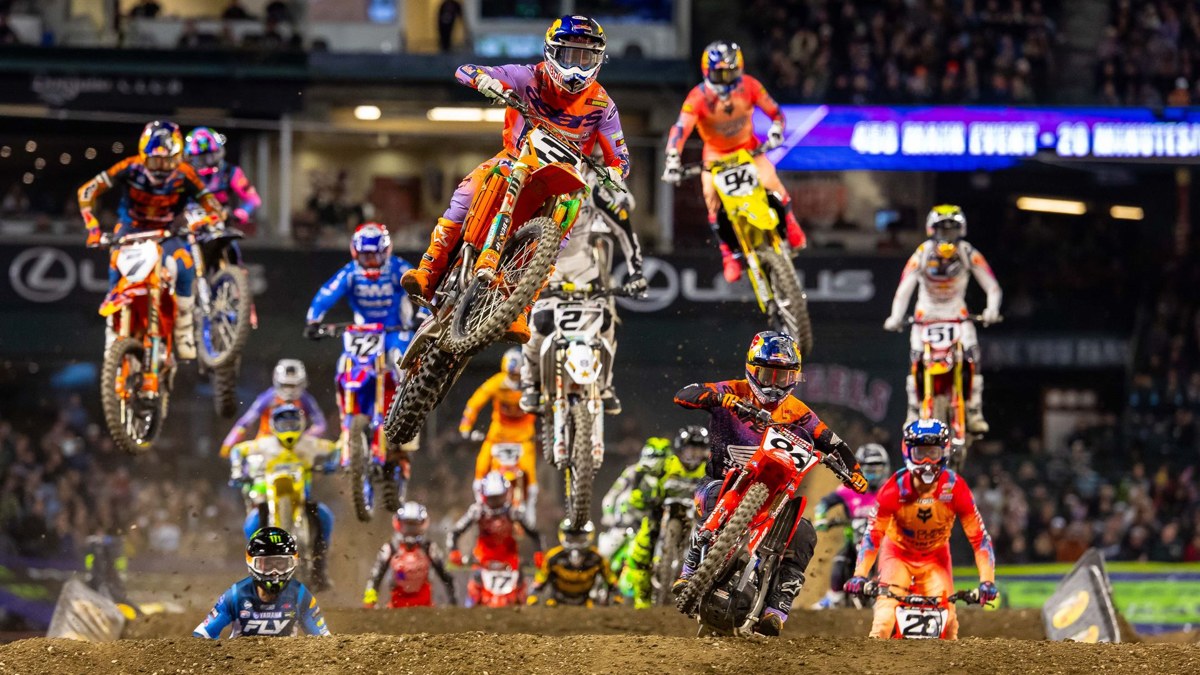
Photo: Align Media, via KTM — the 450SX field at Angel Stadium during an AMA Supercross main event. Sources: 2027 AMA Supercross Rulebook, Section 2.3.4; SMX League announcement, November 2, 2026.
