
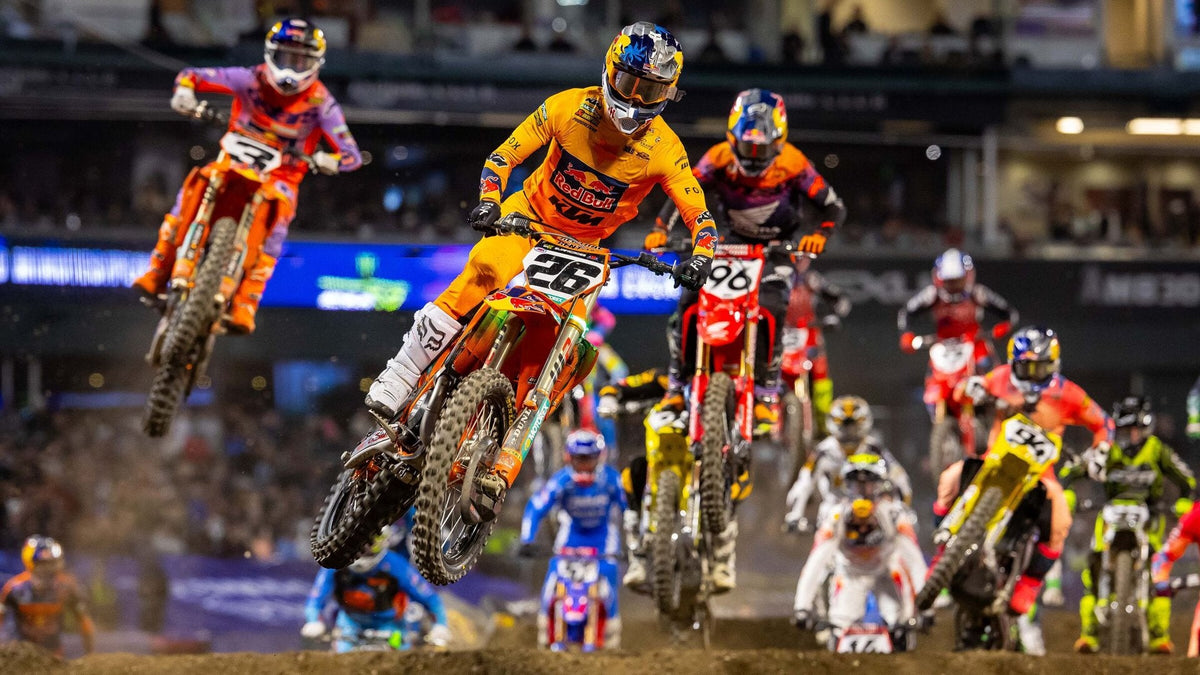
The 2027 Monster Energy AMA Supercross Championship will look different when the gates drop at Anaheim 1.
The American Motorcyclist Association has introduced a series of significant rule changes for the upcoming season, including smaller Main Event fields, a revised qualifying format, new rider eligibility requirements and additional safety regulations.
Main Events will feature just 20 riders instead of the previous 22.
The reduction affects both the 450SX and 250SX classes and brings changes to nearly every stage of the race-night qualification process.
With the 2027 championship scheduled to begin January 9 at Angel Stadium in Anaheim, riders and teams now have a new set of requirements to prepare for.
Supercross Main Events Reduced From 22 Riders to 20
For 2027, AMA Supercross is reducing its Main Event starting fields from 22 competitors to 20.
The decision marks a return to a format used during earlier eras of professional Supercross.
Under the previous system, 22 riders advanced to the Main Event through a combination of Heat Race qualifying positions and the Last Chance Qualifier.
The new system eliminates two positions from the final starting field.
The reduction is intended to produce a smaller field competing on stadium tracks, where space can become limited as riders battle through traffic.
Racer X reported that rider safety, lapped traffic and track deterioration were factors behind the change.
However, fewer competitors do not automatically guarantee fewer incidents or closer racing. The effects will become clearer once the championship begins.
For riders trying to qualify for the Main Event, the change means there will be two fewer opportunities to make the final starting gate.
And that creates additional pressure throughout the evening program.
The Fast 40 Becomes the Fast 38
The Main Event reduction also changes the qualifying structure.
Previously, the 40 fastest riders in each class advanced from timed qualifying into the night program.
For 2027, only the 38 fastest riders will advance under the standard qualifying procedure.
That means the familiar Fast 40 becomes the Fast 38.
Those 38 competitors will be divided between two Heat Races featuring 19 riders each.
Previously, the Heat Races contained 20 riders apiece.
The number of competitors transferring directly from each heat will also decrease.
Instead of the top nine finishers earning automatic Main Event positions, only the top eight will transfer.
Here's how the new standard format works:
2027 AMA Supercross qualifying format:
- 38 riders qualify for the night program.
- Two Heat Races feature 19 competitors each.
- The top eight riders from each heat transfer directly to the Main Event.
- The remaining eligible riders compete in the Last Chance Qualifier.
- The top four LCQ finishers advance.
- A total of 20 riders compete in the Main Event.
The result is 16 riders qualifying directly from the heats and four more advancing from the LCQ.
The AMA rulebook also retains certain alternate and qualifying-exemption procedures, so the simplified format is subject to those specific provisions.
For fans, the changes could make Heat Race transfer positions even more important.
A rider who might previously have secured the final direct transfer position with ninth place will now have to finish eighth or better.
Why the Last Chance Qualifier Still Matters
The Last Chance Qualifier remains one of the most consequential races of a Supercross night.
Despite the smaller Main Event field, four riders will still advance from the LCQ.
Under the standard 2027 format, 16 riders transfer directly from the two heats, leaving 22 from the original 38-rider night-show field eligible for the LCQ.
Those competitors will fight for just four remaining Main Event positions.
The new qualifying structure could make the LCQ even more significant for privateer racers and riders attempting to establish themselves in the professional championship.
Factory-backed competitors are not automatically guaranteed a Main Event position either.
A poor start, crash or mechanical problem in a Heat Race could force an established rider into the LCQ, where the margin for error is small.
The format maintains the familiar last-chance battle while tightening the requirements for reaching the final race.
Fewer Riders Can Enter Each Supercross Class
Another significant adjustment affects the number of riders permitted to enter an event.
For 2027, the maximum number of pre-entries in each AMA Supercross class will decrease from 80 to 66.
This change is separate from the reduction to the 38-rider night-show field.
Not every event historically reaches the maximum number of permitted entries, but the lower cap could matter at rounds attracting larger groups of competitors.
Importantly, the change applies to AMA Supercross. It should not be confused with the separate 40-rider moto format used in AMA Pro Motocross.
The Minimum Professional Racing Age Increases to 18
Rider eligibility will also change in 2027.
The minimum age for an AMA professional Supercross rider license will increase from 17 to 18.
The change follows an earlier increase from 16 to 17 for the 2026 season.
Under the new licensing requirement, riders must meet the minimum age of 18 to obtain the relevant professional AMA Supercross license.
This could affect the timing of professional debuts for younger riders transitioning from amateur competition.
Some athletes may need additional time in development programs before becoming eligible for professional Supercross competition.
The SMX Next development program operates under its own eligibility structure and should not be confused with the professional licensing requirement.
For the next generation of riders, the new age rule introduces another factor in planning the progression from amateur competition to the professional ranks.
New Mandatory Chest and Back Protection
Rider safety equipment will also face additional requirements.
Beginning in 2027, all competitors must wear chest and back protection during AMA Supercross competition.
The AMA specifies protection covering key areas of the torso, including the sternum, ribs and spine.
The protective equipment may be worn underneath or over the rider's jersey.
When the equipment is worn externally, the rider's name and assigned number must remain visible on the jersey or protective equipment.
The requirement establishes a mandatory standard across the professional field rather than leaving chest and back protection as an individual equipment choice.
Teams and riders will need to ensure their existing protective equipment satisfies the updated regulations before the season begins.
Triple Crown Racing Also Gets a New Format
The changes extend to Supercross Triple Crown events.
These special rounds feature three races per class, with an overall result determined through Olympic-style scoring.
In 2027, Triple Crown racing will use the same reduced 20-rider field as standard Main Events.
The number of riders qualifying directly for the three Triple Crown races will decrease from 18 to 16.
Riders qualifying 17th through 38th will compete in the LCQ, with four competitors advancing to complete the 20-rider field.
Another notable change concerns motorcycle usage.
Previously, riders could use a second motorcycle during Triple Crown events under specified conditions.
The 2027 regulations remove that general allowance.
Riders must use the same motorcycle, identified by its main frame, throughout the event. The rulebook provides a limited procedure for replacing a damaged main frame with prior approval from the Technical Manager.
That change adds another consideration for teams preparing motorcycles for the demanding three-race format.
Championship Points Will Be Adjusted
With only 20 competitors starting a Main Event, AMA Supercross is also adjusting its championship points system.
The top four finishing positions will retain their previous values:
- 1st place: 25 points
- 2nd place: 22 points
- 3rd place: 20 points
- 4th place: 18 points
Beginning with fifth place, the 2027 structure awards fewer points than the previous system.
Fifth place will earn 16 points, sixth place 15, and each subsequent finishing position receives one fewer point through 20th place, which earns one championship point.
Previously, championship points extended through 21st place.
The new system brings the points allocation into line with the smaller field.
Although the difference between some positions is relatively modest, consistency and finishing position will remain crucial across the 17-round championship.
The AMA's revised points structure applies to both standard Main Event results and Triple Crown overall classifications.
Additional Rulebook Changes for 2027
The new rulebook also clarifies several race procedures and participant requirements.
Riders must remain in their selected lane after entering a split-lane section, with unauthorized lane changes treated as potential track-cut violations.
The AMA has updated procedures involving starting-gate preparation, including a prohibition on burnouts directly in front of the starting gate before the sighting lap.
Starting blocks are also restricted to silver or black and cannot exceed four inches in height.
The bulletin introduces additional restrictions involving team sponsorship categories, sports betting and prediction-market activity by covered participants.
These provisions form part of the broader effort to standardize racing procedures, equipment and professional conduct ahead of the 2027 season.
New Sound Limits Are Also Coming
The racing-format changes follow another major regulation announced earlier this week.
Beginning in 2027, AMA Supercross will introduce a lower motorcycle sound limit.
The pre-race standard decreases from 112 dB(A) to 109 dB(A), while the post-race inspection limit becomes 110 dB(A).
The sound regulation is supported by the SMX League and participating manufacturers as part of an effort to reduce noise impact and support the sport's long-term sustainability.
Supercross.com previously covered the technical details of the new standard, including what it means for factory teams, privateers and motorcycle development.
Read our full coverage: 2027 Supercross Sound Limit Drops to 109 dB.
What Will the Changes Mean at Anaheim 1?
The 2027 Monster Energy AMA Supercross season begins Saturday, January 9, at Angel Stadium in Anaheim, California.
When riders arrive for the opening round, they will face a revised competition format from the beginning of qualifying through the final Main Events.
For fans, the changes mean smaller starting fields and a more restrictive path into the night show's final races.
For privateers, the tighter qualifying and Main Event requirements could make every transfer position more valuable.
For teams, the new format, motorcycle restrictions and safety requirements introduce several adjustments to preseason preparation.
And for championship competitors, the revised points structure adds another element to consider throughout the season.
The biggest unanswered question is how the new format will affect actual racing.
Will smaller Main Event fields reduce problems with lapped traffic? Could fewer qualifying positions make the LCQ more competitive? And how will riders and teams adapt to the revised regulations?
Those answers will come once racing begins.
What is already certain is that 2027 AMA Supercross will feature 20-rider Main Events, a Fast 38 qualifying system, and some of the most significant competition-format changes in recent seasons.
Supercross.com will continue following the rule changes, official team announcements and preparations for the 2027 championship.
Explore the complete 2027 Supercross Schedule & Tickets for all 17 rounds, beginning with Anaheim 1 on January 9.
Photo: Align Media, via KTM — a full field launches over a jump at Angel Stadium during the Anaheim 1 Supercross. Sources: AMA Competition Bulletin CB2027.01.SX (November 2, 2026); 2027 AMA Supercross Rulebook.
